
Most founders do not have a hiring problem. They have a capacity problem and they have been solving it with the wrong tool. Here is the distinction that changes how you think about every engineering decision after your seed close.
Hiring vs. Capacity: Why Funded Startups Keep Confusing the Two
You are not moving slowly because you need more engineers.
You are moving slowly because you have a capacity problem and you have been trying to solve it with a headcount decision. Those are two different problems. They have two different solutions. And confusing them is one of the most expensive mistakes a funded founder can make, because the confusion does not announce itself. It disguises itself as clarity. It feels like you have diagnosed the issue and chosen the remedy. The job description goes up. The recruiter gets briefed. Things feel like they are moving.
They are not moving. Not in the direction you need.
This article is about the gap between those two things (headcount and capacity ) and why the startup world has spent decades collapsing them into one word.
Headcount is a number. Capacity is a rate.
Say it slowly, because this is the entire argument.
Headcount is the count of engineers on your payroll on a given day. It goes up when someone signs an offer letter. It is a static number. You can report it to your board. You can put it in your investor update. You can feel it go up.
Capacity is how much your team can ship , in a specific time window, against a specific scope, to a specific quality bar. It is a rate of output. It does not go up when someone signs an offer letter. It goes up when that person understands your codebase well enough to make decisions without asking, when they know which tradeoffs are yours to make and which are theirs, when they have absorbed enough context to work independently. That takes time. Unavoidable, non-negotiable time.
The median time for a senior engineer to reach full productivity in a new codebase is three to six months. Not because engineers are slow. Because software systems are complex and context is not transferable by documentation alone. You cannot onboard someone into six months of architectural decisions in a week of reading. The context has to be earned through the work itself.
Which means the gap between headcount and capacity , the window where your new hire exists on payroll but cannot yet independently ship is measured in quarters. And during that entire window, the roadmap item that triggered the hire is still waiting.
You added headcount on day one. You will get capacity on day ninety. Maybe day one hundred and eighty.
The best-funded founders already know this. The numbers prove it.
The best-funded founders in the world have already figured this out and the data shows it.
Companies that closed Series A rounds in the first half of 2024 had an average of just 15.6 employees , 16% lower than the average at the same stage five years ago, according to Carta. Series A teams averaged 16.8 employees in 2025, down from 25.9 in 2021. Series B teams averaged 48.2, down from 72.3 in 2022.
Smaller teams. Same milestones. Same investor expectations. Often better outcomes.
The average headcount among consumer startups that closed a seed round was 6.4 employees in 2022. By 2024, that figure had fallen by nearly half, to 3.5 employees.
These founders are not underhiring because they cannot afford people. They are making a different calculation. They are asking what needs to ship and then finding the most direct path to shipping it, whether or not that path runs through a permanent employment contract.
The market has already shifted. The instinct has not caught up.
Why every stalled roadmap still ends with a job posting
If the distinction is this clear, why does every stalled roadmap still produce a job posting?
Three things are at work.
The first is language. The startup ecosystem has one word for two different concepts: team. When an investor tells you to build the team, they mean build the capacity to execute. But the word team means people on payroll. The advice collapses the distinction before you have a chance to see it.
The second is legibility. A job description posted is visible momentum. A recruiter briefed, a pipeline opened, a round of interviews scheduled ,these produce signals that read as progress to everyone watching: co-founders, investors, early employees. There is no equivalent signal for "we identified a six-week capacity gap and closed it precisely, without adding a permanent line to our burn rate." That decision is better. It is invisible.
The third is the absence of an alternative frame. Most founders have never been taught to think in terms of capacity. They have been taught to think in terms of team size ,how many engineers do you have, how many are you planning to hire, what does your org chart look like in twelve months. The framework most founders are operating from does not contain a slot for "we need to ship X by Y , what is the fastest credible path to doing that?" The closest slot is "hire someone."
So they hire. And the roadmap keeps waiting while the ramp clock runs.
The one question that separates a hiring decision from a capacity decision
There is one question that reliably forces the distinction.
Not: What kind of engineer do we need? That question assumes the answer is already a hire.
Not: What does our roadmap look like? That question opens everything and decides nothing.
The question is: What specifically needs to ship, and by when?
Name the output. Name the deadline. Work backward from there.
If the answer is: we need a core infrastructure layer built and maintained continuously for the next two years by someone who becomes our technical lead and grows with the product , that is a headcount decision. The work is permanent, the ownership compounds over time, and the ramp period is a cost worth paying because the duration of the relationship justifies it.
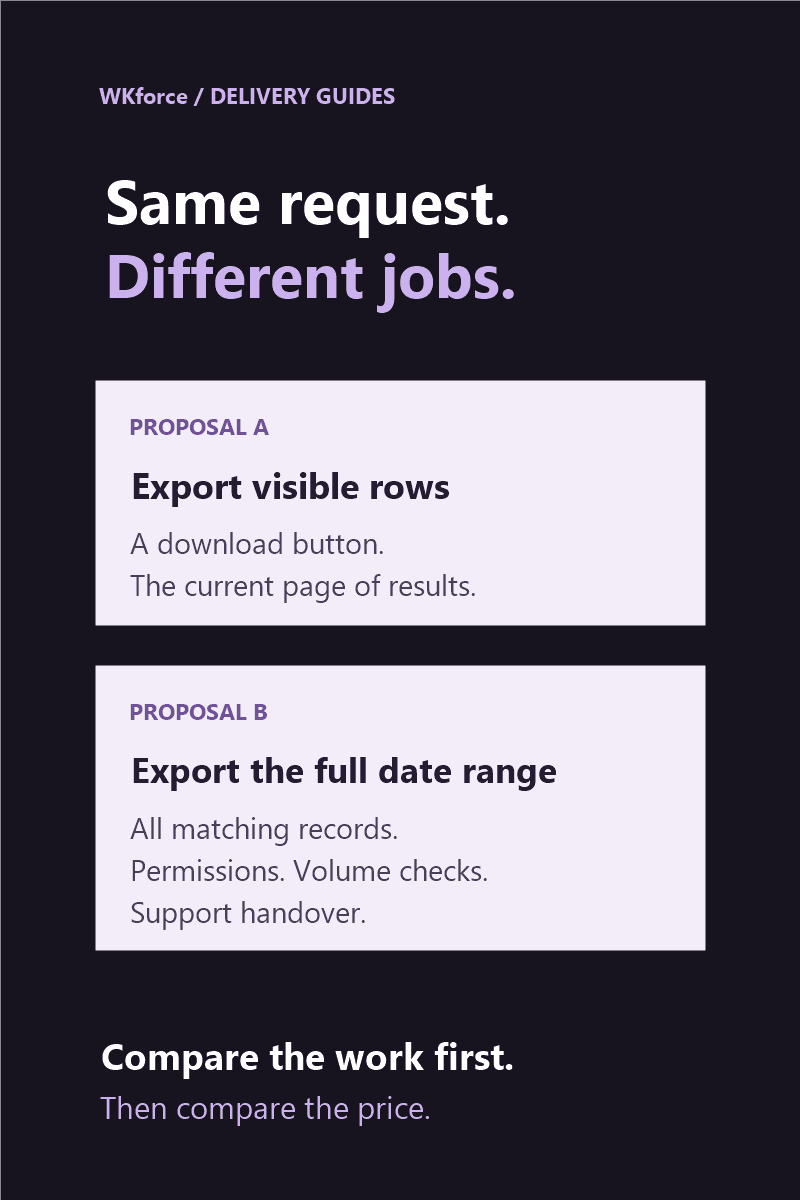
If the answer is: we need the payment integration done and the onboarding flow rebuilt before our Series A conversations start in nine weeks that is a capacity decision. The work is scoped. The deadline is specific. And a senior engineer who joins your payroll today will not be productive enough to solve it in that window. The ramp will outlast the deadline.
Most post-seed founders, when they sit with this question honestly, find that the urgent work in front of them looks more like the second answer than the first. Specific. Time-bound. On a timeline that a ramp period will not survive.
The cost that never shows up in a compensation breakdown
Here is what it does not fix until somewhere between month three and month six.
The specific thing that needed to ship.
The roadmap item that triggered the hire ,the feature that was blocking a partnership, the integration a key prospect asked about, the infrastructure your existing team did not have bandwidth to build , that work is still waiting. The headcount arrived. The capacity did not.
This is the invisible cost. Not the salary, though the salary is real. Not the recruiting fees, though those add up fast. The invisible cost is the time ,the quarter or more between the decision to hire and the moment that hire can independently ship during which the original problem remains unsolved and the runway keeps burning.
Now do that math on a company with a 774-day window to Series A. The median time between seed close and Series A close is approximately 774 days. Add the six to nine months of actual fundraising process pitching, diligence, term sheets and you are looking at roughly 30 months of execution window. One misread decision, made at the moment when the instinct to hire is strongest, can consume a meaningful fraction of that window in ramp time before a single milestone-moving feature ships.
That is the real cost of the confusion. Not the line item. The clock.
Headcount is a resource. Capacity is a result.
You can have more of the first on day one. You cannot have more of the second until the first has had time to become useful.
The founders who separate these two concepts early do not stop hiring. They hire better , for the permanent gaps that require deep ownership and compounding context. And for the urgent, scoped, time-bound gaps, they find a different path to closing them. Faster. Leaner. Without committing five months of runway to a ramp period on work that needed to ship last quarter.
The average seed-stage company now has 6.2 equity-holding employees, down from 10.3 at the 2021 peak. The founders driving that number are not behind. They are ahead. They figured out that the goal was never headcount. The goal was always what ships.
Now that the distinction is clear, see what the full loaded cost of a hire actually looks like when you run every number.
[The Real Cost of Hiring a Senior Engineer at a Seed-Stage Startup →]
And see what closing a capacity gap looks like when you use the right tool for it.
[How WKforce Sprints Work →]