
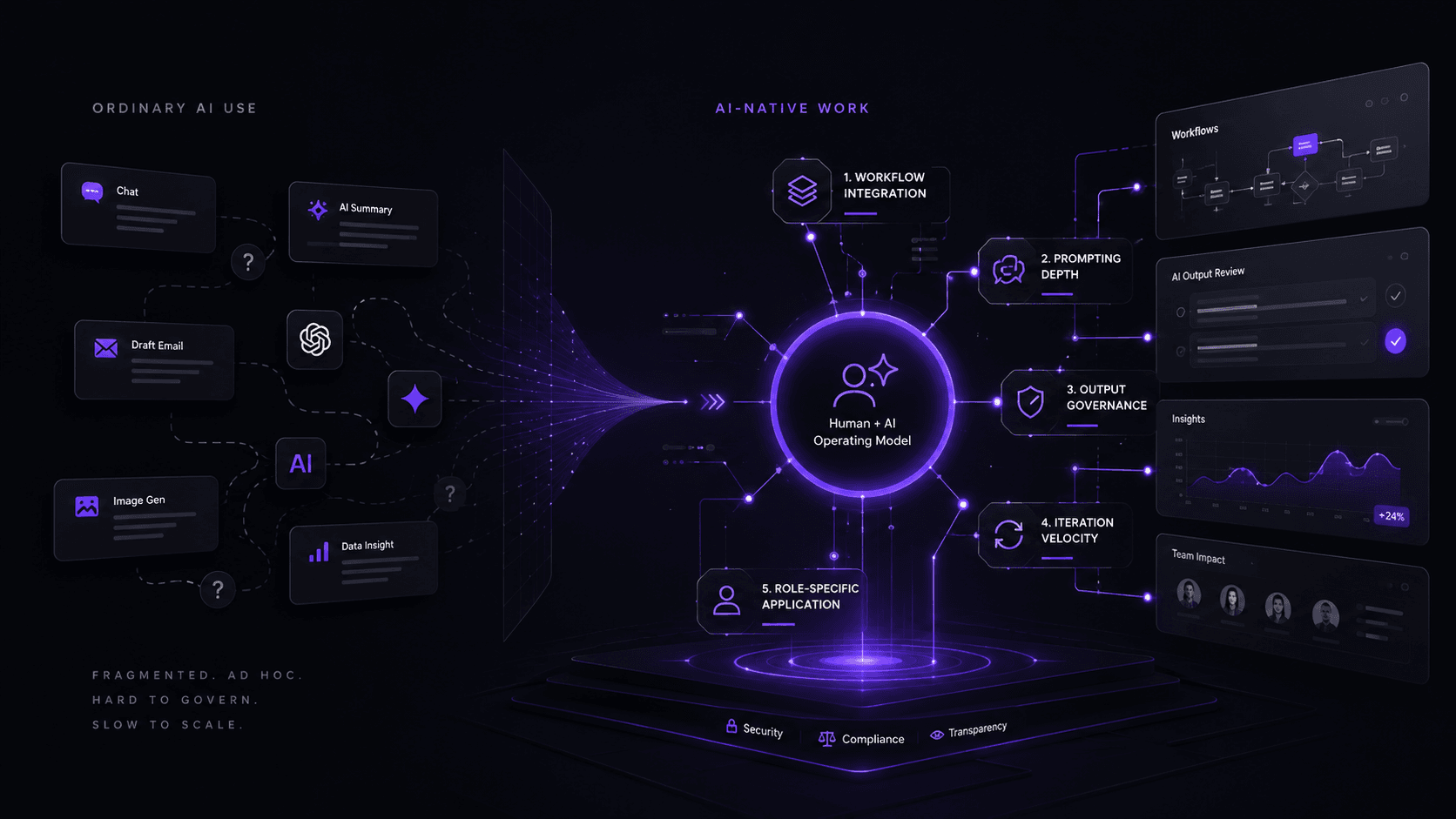
Using a tool and changing how you work are two different things, and most people have only done the first. Here's what "AI-native" actually means, broken into five measurable dimensions, plus a free 15-minute assessment to see exactly where you stand.
Almost every team uses AI now. Very little of their work looks different because of it.
That gap sits at the center of everything we've built, so it's worth slowing down on.
By the usual measures, adoption looks close to universal. People draft with AI, summarize with it, generate first passes at code and copy. Count the tools, the prompts sent, the hours supposedly saved, and you'd conclude the transformation already happened.
Then look at what actually ships. For most teams it's faster in places and otherwise unchanged: same shape, same quality, same bottlenecks.
The reason is simple. Using a tool and changing how you work are two different things, and most people have only done the first.
What most teams have done is bolt AI onto a process they never redesigned. Same steps, same handoffs, same judgment calls, now with a quicker draft sitting in the middle of them. That is using AI. It's common, it's useful, and it isn't where the advantage lives.
Working AI-natively is more specific. The work itself gets rebuilt around what people and AI are each genuinely good at, with a clear decision about where AI belongs, how its output gets checked, and how the pace of the work shifts once a first draft costs almost nothing.
The teams doing this well aren't the ones using AI the most. They're the ones whose operating model has changed.
We wanted to define that difference precisely, because vague language produces vague capability. If "AI-native" means everything, it measures nothing. So we broke it into five things: the five that actually separate someone who uses AI from someone who works AI-natively.
The five dimensions
1. Workflow Integration: where AI actually sits
The first question isn't whether you use AI. It's where.
For most people, AI lives off to the side. They hit a hard task, open a chat window, get an answer, paste it back, and close the tab. The tool is a panic button, reached for in the moment and forgotten between uses. The process underneath never changes.
Anyone who has run a delivery team knows this shape. It's the difference between a junior who asks for help on whatever's in front of them and a senior who has already decided which work to hand off and which to keep. The first is reacting. The second has designed a system.
AI-native work looks like the second one. AI sits at specific, deliberate points in a repeatable process. It's load-bearing, and it's chosen.
The test: if AI disappeared tomorrow, would your process break, or just slow down? "Slow down" means you've built it in. "Nothing really changes" means it was never more than a side errand.
Integration also means knowing where not to use AI: the steps where it adds risk, or quietly removes the judgment that was the entire reason the step existed. This isn't about using AI everywhere. It's about placement.
2. Prompting Depth: how well you hand off intent
Prompting is the most misunderstood of the five, because it's been flattened into a bag of tricks. Magic words. "Act as a." Formatting hacks. That version is real, and it plateaus fast.
The actual skill underneath it would be familiar to anyone who has written a delivery brief. Can you take a fuzzy goal in your head and hand it off clearly enough that someone, or something, can execute it well? That means breaking the problem down, naming the constraints that matter, showing what "good" looks like, and stating how you'll judge the result.
It looks far less like a clever incantation and more like briefing a sharp new hire who has no idea what you actually want.
The principle: your output quality is capped by the context you hand over, not by how clever your wording is. Most people who think they're "bad at prompting" are simply under-briefing: handing over a fraction of what they know and hoping the rest gets guessed.
Depth shows up in a willingness to front-load context that feels tedious to write. The people who do it understand that the briefing is the work.
3. Output Governance: calibrated trust
This is the dimension we hold the strongest opinions about, because it's the closest to the discipline that actually produces reliable delivery.
Anyone who has worked in a regulated, documentation-heavy environment (insurance being a clear example) learns early that confident output and correct output are not the same thing, and that the cost of confusing them is rarely yours alone to absorb. You build review habits sized to the stakes. You don't treat every document the same, and you never trust fluency as a proxy for accuracy.
AI makes that discipline more important, not less. It generates plausible work cheaply, which moves both the bottleneck and the value from making the work to checking it.
Output Governance is knowing what to trust and what to verify. It isn't blanket suspicion, which throws away the speed you came for. It isn't blind acceptance either, which ships confident, fluent, wrong work straight to a client. It's calibrated trust: knowing where these systems fail (invented specifics, reasoning that looks sound and isn't, the quiet omission) and building a check proportional to what a mistake would cost.
The heuristic: match your verification to the cost of being wrong. A throwaway brainstorm needs almost none. A figure going in front of a client, a clause in a contract, a line headed for production: that gets checked, every time.
This is the dimension that most separates professionals from casual users. It's also the one that simply doesn't exist for someone who has only ever used AI on low-stakes tasks. You can't govern output you were never accountable for.
4. Iteration Velocity: running more loops
When a first draft costs almost nothing, the smart way to work changes.
The old logic was plan carefully, then execute once, because execution was the expensive part. AI flips that for a large slice of work. It's now cheaper to put a rough version on the table, react to it, and refine, because looking at something concrete sharpens your thinking faster than staring at a blank page ever will.
Teams working AI-natively use this deliberately. They treat early output as disposable, run tight loops, and explore the range of possible answers instead of committing to the first one that seemed fine.
The reframe: AI-native isn't doing the same work faster. It's running more loops in the same time, and landing somewhere a single pass would never have reached.
Velocity has a failure mode, though, and it's worth saying plainly: speed without governance is just fast mistakes, produced at scale. Dimensions 3 and 4 pull against each other on purpose. High velocity and real governance together is the signature of working AI-natively. Either one on its own is a known way to fail, whether that shows up as fast confident wrong work, or as careful work so over-checked it loses the only advantage it had.
5. Role-Specific Application: where it actually counts
Generic AI use, tidying emails or summarizing a meeting, produces generic, marginal gains. Everyone gets those. They don't add up to much, and they don't compound.
The real return comes from applying AI to the part of your job that takes the most judgment: the work that's genuinely hard to explain to someone outside your role. What that is for a delivery manager is not what it is for a designer, an underwriter, or an engineer. Teams working AI-natively know their own highest-value applications, the few places where AI pointed at real domain knowledge changes the quality or scale of what they can produce, not just the speed of their admin.
The tell: the most valuable AI use in any role is usually the thing that's hardest to explain to someone outside that role. If your AI use would look identical to everyone else's, you haven't found your spot yet.
This is why a single, generic "AI skills" score is misleading. Nativeness is always relative to the work in front of you.
How we measure this, and what we don't claim
A benchmark you can't see inside isn't worth trusting, so here is what this is, plainly.
The assessment scores you across these five dimensions and places you in an AI-Nativeness tier, with a profile showing where you're strong and where you're thin. The dimensions aren't decoration. Each one isolates a behavior that separates integrated, governed, role-aware AI use from casual tool use, and a few of them pull against each other on purpose, so the profile rewards balance instead of enthusiasm.
Here is what we won't pretend. This isn't a certificate, and it isn't a verdict on your worth as a professional. It's a structured signal: an honest read of how AI shows up in your work today and where the next improvement sits. The framework reflects how we think disciplined AI use actually behaves, and we'll keep sharpening it as the evidence and the tools move. We would rather say that than dress up a fast-moving field as though it were already settled.
We built this from the seat of people who have had to answer for what a team delivered, not from a whiteboard. That is the standard we hold it to.
See where you stand
If the distinction in this piece felt familiar, if you suspect you're using AI more than you're working AI-natively, the assessment will tell you exactly where the gap is.
You'll get a score, your AI-Nativeness tier, a five-dimension profile, a shareable card, and concrete next steps. About 15 minutes. Free. No account.
There's an individual version for builders, and a team version for founders who want to see where their group is strong and where execution is thin.
Using AI is common. Working AI-natively is different. Find out which one describes your work.